The importance of Aboriginal and Torres Strait Islander languages, and supporting language communities
Aboriginal and Torres Strait Islander languages are integral to communities, cultures and homelands. These languages are important to the strength and success of communities. The Languages Policy Partnership (LPP) asserts and advocates the critical role that languages play in the ongoing and future health, well-being and success of Aboriginal and Torres Strait Islander people.
Languages Policy Partnership
“We see these no-good things happened to us, to our country, our culture, and our language. Some people now have little language, and some still have much. We have come together to make change, to make our languages strong again, to make our people and culture strong again - to stand proud with our languages”.
- Aboriginal and Torres Strait Islander representations, Languages Policy Partnership.
In 2022, the Joint Council endorsed the creation of the Languages Policy Partnership (LPP) under the National Agreement for Closing the Gap. The LPP has been established to create a shared approach to progress and achieve Outcome and Target 16 so that there is a sustained increase in the number and strength of Aboriginal and Torres Strait Islander languages spoken by 2031. The LPP does this through the commitment and opportunities within the National Agreement and the LPP Agreement to Implement.
The partnership includes nineteen members: five leaders from the Coalition of Peaks, five independent Aboriginal and Torres Strait Islander community language experts, and nine senior-level whole-of-government representatives from federal, state and territory governments. The group meets four times a year to consider progress and how it can collectively keep working together to ensure that communities across the country are effectively supported to achieve their language aspirations and outcomes.
The LPP is entering its fourth year as a partnership. During its first term, the group worked on establishing its foundations and processes, and began identifying and mapping the language landscape, including its national priorities. The LPP is able to make recommendations to the Joint Council to seek their support for action, and it has begun doing so by delivering the national priorities and actions to be taken. As it is a relatively new partnership model, and to ensure it is learning and growing as much as it can along the way, the LPP is currently undertaking an evaluation that is set to be completed in mid 2026. The LPP will continue working together through the next three years to achieve its objectives and to see progress and success for Outcome and Target 16.

LPP members together at their second meeting in June 2023.
Outcome and Target 16 of Closing the Gap
The LPP welcomes the introduction of Target 16 and considers the target interconnected with many other socio-economic targets of Closing the Gap. Target 16 focuses on the power, strength and cultural identities and connections of Aboriginal and Torres Strait Islander communities. It states:
Outcome 16:
Aboriginal and Torres Strait Islander cultures and languages are strong, supported and flourishing
Target 16:
By 2031, there is a sustained increase in the number and strength of Aboriginal and Torres Strait Islander languages spoken.
Outcome and Target 16 are broad, and there is limited adequate national data to measure progress against the Target. In response, the LPP has developed a Data Policy Position that clearly defines how we are to consider and measure what a strong, supported, and flourishing language is. The LPP will continue its work on data development to ensure the Outcome and Target are measurable in the way that Aboriginal and Torres Strait Islander communities need it to be.
Have your say on the LPP’s national priority areas!
The LPP’s seven national priority areas have been identified, led by the LPP’s Aboriginal and Torres Strait Islander representatives and informed by Aboriginal and Torres Strait Islander community members.
The LPP welcomes the continual input on the priority areas through an online survey, or you can provide your thoughts on sound recording or video, by recording and emailing it to LanguagesPolicyPartnership@firstlanguages.org.au
To date, over 97% of respondents have expressed their support for the national priorities identified by the LPP. You can view the results in the Community Response Paper to the LPP Priorities.
Have your say!
The National Languages Policy Partnership has identified seven national priority areas to achieve Target 16 of Closing the Gap, captured on the LPP Priorities on a Page. We invite Aboriginal and Torres Strait Islander people to provide their thoughts on the priority areas. To do so, please visit the survey here. You may also provide your thoughts on video, by recording and emailing the video to LanguagesPolicyPartnership@firstlanguages.org.au.


LPP Members at Meeting 1, Hobart, Tasmania

LPP Members at Meeting 7 in Adelaide, South Australia
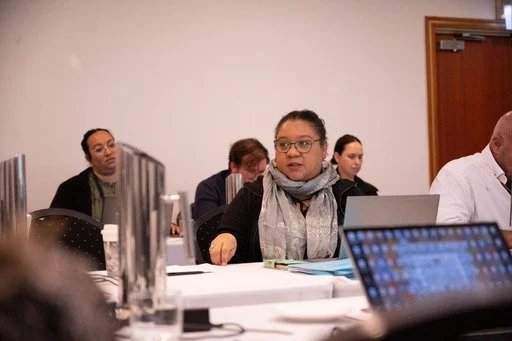
LPP Meeting 7 deliberations
Meetings of the Languages Policy Partnership
The LPP meets 4 times a year. The 2026 meetings are:
Meeting 13 - 18th & 19th of March, Melbourne, VIC
Meeting 14 - 19th and 20th of May, online.
Meeting 15 - 5th & 6th of August, location TBD.
Meeting 16 - 11th of November, location TBD.
Previous meeting information:
2026
Meeting 14 - 19 & 20 May, online
- Summary report/ CommuniqueMeeting 13 - 18th & 19th March, Melbourne, VIC
- Summary report/ Communique
2025
Meeting 12 - 19th of November, online
- Summary report/ CommuniqueMeeting 11 - 10th and 11th of September, Sydney, NSW
- Summary report/ CommuniqueMeeting 10 - 21st and 22nd of May, Darwin, NT
- Summary report/ CommuniqueMeeting 9 - 4th and 5th of March, Canberra, ACT
- Summary report/ Communique
2024
Meeting 8 - 11th & 12th of December, Brisbane, QLD
- Summary report/ CommuniqueMeeting 7 - 3rd and 4th of September, Adelaide, SA
- Summary report/ CommuniqueMeeting 6 - 11th and 12th of June, Cairns, QLD
- Summary report/ CommuniqueMeeting 5 - 12th and 13th of March, Melbourne, VIC
- Summary report/ Communique
2023
Meeting 4 - 12th of December, online
- Summary report/ CommuniqueMeeting 3 - 10th and 11th of October, Broome, WA
- Summary report/ CommuniqueMeeting 2 - 21st and 22nd of June, Sydney, NSW
- Summary report/ CommuniqueMeeting 1 - 20th and 21st of March, Hobart, TAS
- Summary report/ Communique
For more information
- subscribe to our newsletter
- follow us on socialmedia or read our updates.
LPP membership
The Languages Policy Partnership has members representing all Australian, state and territory Governments and Aboriginal and Torres Strait Islander members. The LPP is co-chaired by the CEO of First Languages Australia as the national peak organisation for Aboriginal and Torres Strait Islander languages, and the Deputy Secretary of the Department of Infrastructure, Transport, Regional Development, Communication and the Arts.
Secretariat:
First Languages Australia is the industry peak body leading this work. We share the partnership’s secretariat work with the Commonwealth Government’s Office for the Arts.
Coalition of Peaks organisation representatives
Karina Lester, Mobile Languages Unit
Vicki Couzens, Victorian Aboriginal Corporation for Languages
Daisy Allan, Tasmanian Aboriginal Centre
Beau Williams, First Languages Australia
Karen Paterson, First Nations Media Association
Independent Aboriginal and Torres Strait Islander experts:
Patsy Ngalu Bedford (Bunuba)
Daryn McKenny (Gamilaraay and Wiradjuri)
Leitha Assan (Badhulaig)
Samantha Armstrong (Pertame)
Gulwanyang Moran (Birrbay and Dhanggati)
Government members:
Philip Smith, Department of Infrastructure, Transport, Regional Development, Communications, Sports and the Arts, Commonwealth Government
Brendan Moyle, Aboriginal Languages Trust, New South Wales Government
Shelagh Magadza, Department for Local Government, Sport and Cultural Industries, Western Australian Government
Kathy Parton, Department of Women, Aboriginal and Torres Strait Islander Partnerships and Multiculturalism, Queensland Government
Mellissa Gray, Department of Premier and Cabinet, Tasmanian Government
Dorrelle Anderson, Department of Housing, Local Government and Community Development, Northern Territory Government
Bronwyn Milera, Department of Education, South Australia Government
Rachielle Laine-Barclay, Office for Aboriginal and Torres Strait Islander Affairs, Australian Capital Territory Government
Angela Singh, Department of Education, Victorian Government
For enquiries about the Languages Policy Partnership, contact our secretariat team at LPP@firstlanguages.org.au